

Guam KAL Plane Crash Incident
Attorney Kim Dong-min Preparing for Lawsuit Against U.S. Government
Published in News Focus, November 1997
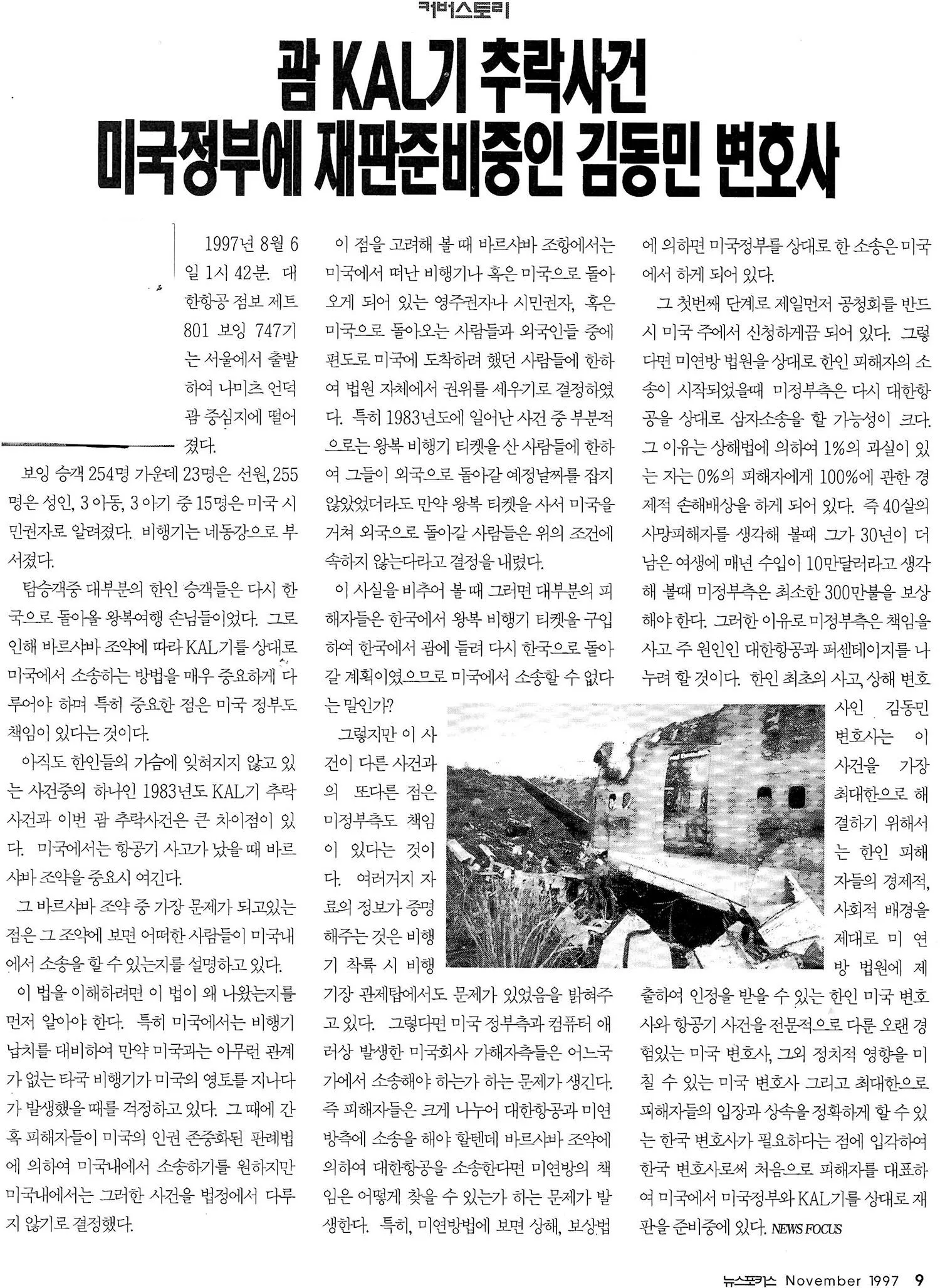
At 1:42 a.m. on August 6, 1997, Korean Air flight 801, a Boeing 747, departed from Seoul and crashed in the hills near Nimitz Hill in Guam. Of the 254 passengers onboard, 23 were crew members, 255 were adults, 3 were children, and 3 were infants. Among them, 15 were U.S. citizens. The plane broke into four pieces upon impact.
Most of the Korean passengers were round-trip travelers returning to Korea. As a result, under the Warsaw Convention, lawsuits against Korean Air in the U.S. must be carefully considered, and it is especially important to note that the U.S. government could also be held accountable.
One unforgettable incident for Koreans is the 1983 KAL plane crash. Unlike that incident, the current Guam crash differs significantly. In the U.S., the Warsaw Convention is considered crucial in aviation accidents.
A major issue in the Warsaw Convention is determining who is eligible to sue within the U.S. In order to understand this law, it is important to consider why and how it was created. The U.S. was mindful and concerned about foreign planes flying over U.S. territory and the legal implications of such incidents. If foreign victims sought justice in U.S. courts, the law dictates that such cases would not be handled domestically.
Considering this, can victims who purchased round-trip tickets from Korea to Guam and back sue in the U.S.? This case differs because the U.S. government also bears responsibility. Various data prove there were issues with air traffic control during the plane's landing. This raises the question: where should victims sue the U.S. government and the American company responsible for the computer error?
Victims would likely need to file lawsuits against both Korean Air and the U.S. federal government. Under the Warsaw Convention, suing Korean Air is possible, but how can the U.S. government be held accountable? According to U.S. federal law on personal injury and compensation, lawsuits against the U.S. government must be filed within the U.S.
The first step requires filing a petition for a hearing in a U.S. state. If Korean victims proceed with this lawsuit, the U.S. government may bring in Korean Air as a third-party defendant. This is possible based on personal injury law; even being 1% at fault leads to 100% financial responsibility for damages. For example, if a 40-year-old deceased victim had an annual income of $100,000 with 30 years left to work, the U.S. government could be liable for at least $3 million. Therefore, the U.S. government would likely seek to share responsibility with Korean Air.
Kim Dong-min, the first Korean attorney specializing in aviation accidents, is preparing for this case. He believes it is essential to involve Korean-American lawyers familiar with U.S. federal courts, experienced U.S. aviation attorneys, politically influential U.S. lawyers, and Korean attorneys who can accurately represent the victims' positions and inheritance issues.
As the first Korean lawyer to represent the victims, he is preparing for a lawsuit in the U.S. against both the U.S. government and Korean Air.
NEWS FOCUS
News Focus, November 1997

